

Argo Space wants to run its fleet on water. That makes it a future buyer for lunar ice
Three former SpaceX engineers are building spacecraft that split water into rocket propellant in orbit. Their first demo never got to fire, and a Moon delivery is already on the books.
Argo Space, an El Segundo startup founded in late 2022 by brothers Robert, Ryan and Kirby Carlisle, all former SpaceX engineers, is building its spacecraft around one propellant: water. Ars Technica’s profile this week laid out the plan. Launch with liquid water, use solar power to split it into hydrogen and oxygen gas in orbit, and burn those in an ordinary small rocket engine.
The trick is storage. Water sits in a tank as a dense liquid at modest pressure, so there’s no cryogenic plumbing to babysit for months. Argo also uses the water to cool the thrusters and avionics and as radiation shielding, so more of the vehicle’s mass ends up as propellant.
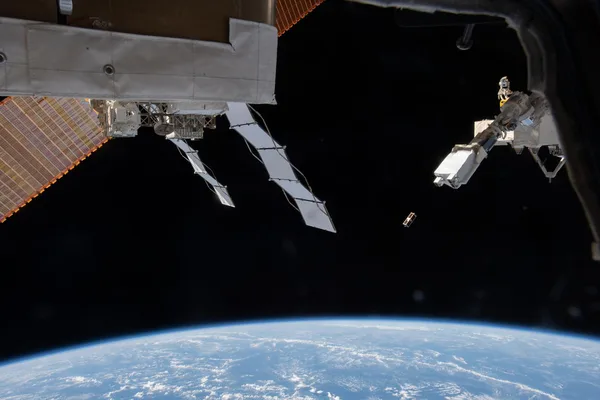
Water thrusters aren’t new. NASA flew a pair of small satellites with one in 2017, and Momentus has used water for in-space maneuvering. The difference is scale. Argo’s next vehicle, Chiron, is about 200 kilograms and is meant to deliver more than 2 km/s of delta-v. The one after that, Argonaut, is specced at up to 1,400 kilograms of payload and as much as 17 km/s of delta-v per tank.
Here’s the part that matters for space resources. Every lunar ice business plan runs into the same question: who buys the water? Cryogenic oxygen and hydrogen need mining, purification, electrolysis, liquefaction and cold storage on the Moon before anyone pays. A fleet that refuels with plain water moves the electrolysis step onto the customer’s spacecraft. The product a lunar miner would sell gets simpler: clean water in a tank. Robert Carlisle told Ars the company’s “profit motive” is to harvest it from the Moon eventually. We’d add that a buyer whose fuel spec is “water” is the easiest customer a lunar ice prospector could hope to meet.
Now the cold water. Argo’s first demonstrator, Navigator, flew on a Falcon 9 rideshare in July. One of its two solar arrays didn’t deploy, the spacecraft ran out of power, and the propulsion system never fired. The two Chiron flights in 2027, for an undisclosed national security customer, are supposed to fix that. Neither is on a Falcon 9, because Argo couldn’t find a rideshare seat in time.
Meanwhile ispace has a signed contract for Argonaut to carry its Alpine relay satellite to lunar orbit “as early as 2027.” That’s the first piece of a planned Lunar Connect constellation of at least five satellites by 2030. ispace’s investor notice keeps the price undisclosed. So the first water-powered Moon delivery could be booked into the same year the propulsion system gets its first real test. Ars puts the company at $20 million raised and fewer than 30 people.
For job seekers, a team that size hires generalists who can own a whole subsystem: electrolysis and fluid systems, power (Navigator’s failure was a power failure), thermal, and guidance for orbit transfers. El Segundo is dense with this work. Our El Segundo jobs page and the jobs board list current openings in the area. For the resource side, see what we know about lunar water ice and ISRU basics.
What would change our view: a Chiron flight that fires its thrusters but shows the electrolyzer can’t keep up with real burn demands. That would push water back to being a niche thruster fluid instead of a reason to mine the Moon.
- Ars Technica: This space company is betting its future on a propellant available everywhere (Nov 3, 2026)
- ispace: Argo Space and ispace-U.S. finalize contract for lunar satellite delivery, Mission 2.5 (Sep 17, 2026)
- ispace investor notice: Launch contract with Argo Space for Mission 2.5 (Sep 17, 2026)
Mars Mining Co. is an independent news site. It is not affiliated with NASA, JAXA, ESA, SpaceX or any company mentioned. Nothing here is investment advice. Full disclaimer.