

Artemis III will test docking. The Moon landing hinges on propellant it won't test
NASA's 2027 Earth-orbit flight docks Orion with both commercial landers. The harder problem, moving enough fuel to reach the Moon, sits outside the mission.
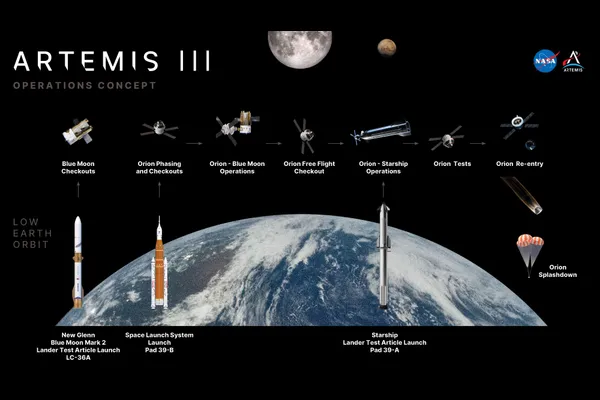
NASA laid out the flight plan for Artemis III on Oct. 23, and it’s a 14-day mission in low Earth orbit, not a landing. Astronauts Randy Bresnik, Frank Rubio, Andre Douglas and ESA’s Luca Parmitano will fly Orion up to meet test versions of both crewed landers. Blue Origin’s Blue Moon Mark 2 launches first and can wait in orbit for up to 30 days. Orion docks with it, and the crew spends about two days inside checking the cabin and life support. Then a Starship V3 test article launches, Orion docks to its nose for up to two hours, and nobody goes aboard.
At the same briefing, officials held to mid-2027 for Artemis III and 2028 for two crewed landings on Artemis IV and V.
Docking is worth rehearsing. It’s also the part of the lunar plan that’s easiest to rehearse.
The hard part is fuel. A day before the briefing, NASA’s safety panel member Charlie Precourt put the number of refueling flights for the lander at “around 22.” Elon Musk replied that the real figure would be “more like 6 to 8.” Ars Technica notes that even at twice-weekly launches, a 22-flight campaign would take about three months to fill a depot. SpacePolicyOnline reports that SpaceX expects its first in-space cryogenic transfer early next year, with an uncrewed lunar landing test in late 2027.
Blue Origin has changed its answer to the same problem. It dropped orbital refueling and will now use three smaller Blue Moon Mark 1 vehicles as tugs to push the Mark 2 lander into lunar orbit. That’s a different logistics bet. You get fewer launches to aggregate, but more separate vehicles that all have to work.
Here’s our read for space resources. The two landers now look like two answers to one question: how do you get enough propellant to the Moon when all of it has to be launched from Earth? Neither answer involves the water ice that’s a big part of why NASA wants the South Pole in the first place. That’s normal for a first landing. But it makes the case for lunar water as a propellant source easy to put in numbers. Every tanker flight you can’t avoid is a flight a lunar supplier would one day compete with. The payload math behind every Moon base plan depends on how that tanker count turns out.
For job seekers, this mission rewards rendezvous and proximity-operations engineers, guidance and navigation people, flight controllers who can coordinate across three companies, and cryogenic fluid management specialists. Those are roles worth filtering for on our jobs board.
What would change our mind: if SpaceX’s transfer demo moves tens of tonnes cleanly and NASA’s refueling estimate drops toward the single digits, the 2028 landing looks much more real than it does today.
Mars Mining Co. is an independent news site. It is not affiliated with NASA, JAXA, ESA, SpaceX or any company mentioned. Nothing here is investment advice. Full disclaimer.