

Astrolab plans to double its rover team next year. Seven of its 51 openings pay by the hour
The Hawthorne company behind the FLIP and FLEX rovers expects to grow from 160 people and move to an 85,000-square-foot building in Torrance. Its 51 open roles lean on avionics, test and hands-on technicians.
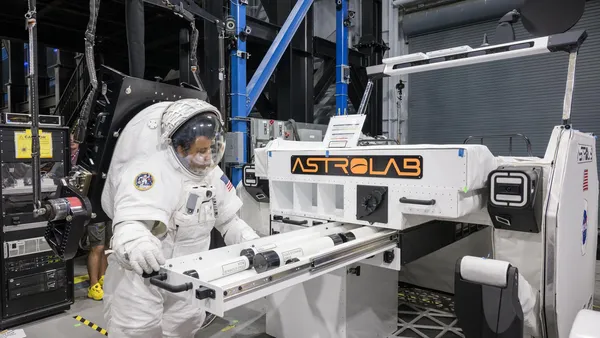
Astrolab expects to double its 160-person headcount next year and move out of a 24,000-square-foot former neon sign factory in Hawthorne into an 85,000-square-foot building in Torrance, the Los Angeles Times reported Friday. The timing tracks two deadlines. FLIP, the company’s $50 million demonstration rover, is due to launch in January on Voyager’s Griffin-1 lander, bound for the lunar south pole. And the $219 million NASA contract Astrolab won in May for a crewed lunar vehicle, built on its larger FLEX design, points at a 2028 delivery on a Blue Origin lander.
FLIP is a small machine with a resource job. Per the Times, it will look for lunar resources, build a 3-D map of its landing region and measure dust. It drives itself between waypoints that operators in Hawthorne pick. “We went from blank sheets to the finished rover in about 18 months,” founder Jaret Matthews told the paper.
Who gets hired
On Friday, Astrolab’s own careers board listed 51 openings, every one tied to Hawthorne. Avionics and production-and-test lead with eight roles each. Seven are hourly shop jobs: integration, harness, structures, R&D fabrication and engineering technicians at $35 to $51 an hour, plus two CNC programmer roles that top out at $80 and $100. Add a quality inspector at $100,000 to $135,000 and a mechanical engineer slot open to entry-level applicants at $100,000 to $157,000.
Compare that with Lunar Outpost, the rival Pegasus builder, which opened a Colorado building for 250-plus people this week. Its board leaned on engineers, with one technician posting. Astrolab is staffing like a factory. If you’ve built aircraft harnesses or run a five-axis mill, you qualify for these jobs without a space résumé. Our guide to breaking into aerospace without an aerospace degree covers how to frame that experience.
One detail software people should know: Astrolab’s full-stack developer posting says it wants code written “with little to no assistance from any large language models.”
Astrolab isn’t on our board yet. Its neighbors are. See open roles in Hawthorne, Torrance and Long Beach, where Vast is adapting its station design for a lunar habitat. The Times also names Rosemead’s Cislune, six people working on lunar excavation and bricks, and GITAI USA in Torrance, building construction and mining robots. Rover autonomy career ladders are mapped in robotics career paths.
What would change our view: January. If Griffin-1 slips or FLIP doesn’t survive its first week on the surface, the doubling plan rests on one NASA contract and a 2028 date, and hiring at that pace gets harder to justify.
Mars Mining Co. is an independent news site. It is not affiliated with NASA, JAXA, ESA, SpaceX or any company mentioned. Nothing here is investment advice. Full disclaimer.