

NASA restarts the Mars sample return question, and gives itself until the end of 2027 to answer it
A small in-house team starts in January to find a cheaper way to bring Perseverance's tubes home. The hard part hasn't changed: getting anything off the surface of Mars.
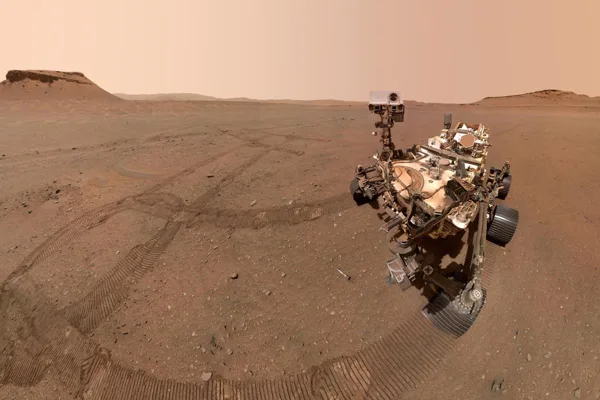
NASA will stand up a new team in January to work out how to get Perseverance’s samples back to Earth. Mars program executive George Tahu described the Perseverance Sample Retrieval Architecture (PSRA) strategy team at a planetary science town hall on Nov. 12, SpacePolicyOnline reported. The goal is “a high-level architecture approach and recommendations by the end of next year.”
Why a restart? The old Mars Sample Return plan, a NASA lander plus a small rocket to loft the tubes into orbit for an ESA return craft, saw its estimated cost climb to $11 billion. Last year’s FY2026 budget request called for cancelling it, and Congress put $110 million into a general “Mars Future Missions” line rather than into MSR itself.
Meanwhile, the rocks are still waiting. As of July 2025, Perseverance had filled 33 tubes, counting rock cores, regolith, an air sample and witness tubes. Ten of them sit at the Three Forks depot in Jezero Crater, and the other 23 ride on the rover.
The interesting word is “constraints”
Tahu said the team will look at “evolving industry capabilities” and whether “certain constraints can be removed,” along with new acquisition approaches. Read that next to the $11 billion figure. The old design was a bespoke government mission with layer upon layer of requirements. A team asked to question those requirements, and to look at what industry can now sell, is being pointed toward buying parts of the job as a service.
For space resources, this is the more useful story. Sample return is the smallest possible version of a Mars export business: pick up a few kilograms of material, launch it off the surface, meet something in orbit and bring it home. Every proposal to move Mars material anywhere runs into the same ascent problem. Whatever architecture NASA settles on will be the first real price tag for lifting cargo off Mars, and anyone pitching Mars-sourced materials should be watching that number. (Our guide to Mars regolith chemistry covers what’s actually in the ground.)
On jobs, set expectations low for now. NASA’s statement says the team will be filled by three year-long detail assignments for current NASA civil servants, so there’s no outside hiring in this phase. Outside work would only come later, if contracts follow the recommendation, and it would most likely land with the companies that build landers, small launch vehicles and spacecraft. Our who hires and where guide and the jobs board show where those teams are today.
There’s also a clock. China plans to launch Tianwen-3 in 2028 and return Mars samples in 2031. A U.S. recommendation landing in late 2027 makes beating that date unlikely, in our view, though a cheaper commercial approach could close some of the gap.
What would change our mind: if the PSRA team recommends sticking with a government-built lander and ascent vehicle, the industry angle mostly disappears, and the price tag probably won’t fall far.
Mars Mining Co. is an independent news site. It is not affiliated with NASA, JAXA, ESA, SpaceX or any company mentioned. Nothing here is investment advice. Full disclaimer.