

Perseverance found the Mars dust that won't shake off. Any Mars mine will make more of it
Years of grime on spacesuit swatches riding the rover show ultrafine particles down to about 100 nanometers. That's a crew-health finding, and a design brief for anyone planning to dig on Mars.
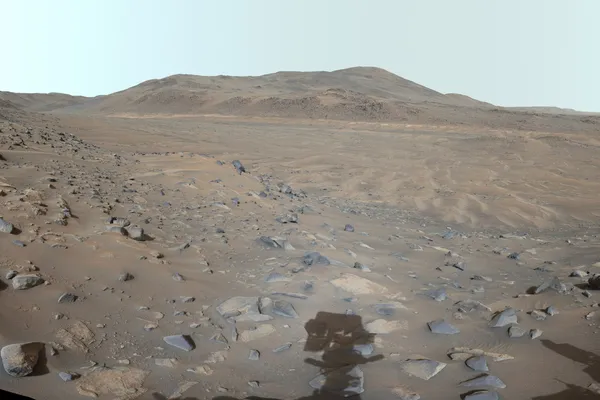
Some of the most useful data Perseverance has sent home came from a few swatches of fabric on its deck. The rover carries small samples of spacesuit materials, including Teflon and Vectran, on the calibration targets for its SHERLOC and PIXL instruments. Over 1,645 Martian days, PIXL measured the dust that settled on them. NASA summarized the results on Oct. 26, ahead of the paper’s publication in the Proceedings of the National Academy of Sciences.
Earlier missions could resolve Mars dust down to about 3 micrometers. PIXL saw fine particles under 2.5 micrometers and ultrafine ones around 100 nanometers. On Earth, particles under 2.5 micrometers are the ones that get deep into lungs and the bloodstream. Static charge seems to decide what sticks where. Lead author Scott VanBommel of Washington University in St. Louis put it simply: the big clumps shake off over time, but “the smallest particles stay behind.”
The chemistry is the other half. NASA describes the dust as rich in sulfur, chlorine and iron, with more silica than lunar dust, plus phosphorus and signs of calcium sulfate. It also carries perchlorates, which can disrupt thyroid function. Mars grains are rounder and less abrasive than the Moon’s, so the problem looks less like sandpaper and more like a fine, reactive film that clings to fabric.
Why this is a mining story
Most Mars resource plans start by moving regolith. You scoop it, crush it, heat it to drive off water, or feed it to a reactor. Every one of those steps makes dust, and the chemistry of Martian regolith means that dust is salty and oxidizing. A rover that picked up a durable coat of ultrafine grains just by sitting on the surface for years is a fair hint at what a processing plant will deal with daily.
That shifts some costs we tend to wave away in ISRU plans. Seals, filters, airlocks and suit layers become consumables with a replacement rate. NASA points to suitports and dual-chamber airlocks as ways to keep dust out of living space, and to its Electrodynamic Dust Shield, which cleared lunar regolith from glass and radiator surfaces after landing on Firefly’s Blue Ghost Mission 1 in March 2025. None of that has been tested at Mars scale yet.
Who gets hired for this
Dust doesn’t get its own department, so the work spreads across job titles. It goes to materials and coatings engineers choosing suit and habitat fabrics, life-support engineers designing filtration, and electrostatics specialists building dust shields. Toxicologists and flight surgeons set the exposure limits, and test engineers run vacuum chambers full of regolith simulant. Earth mining already pays people to control dust and protect workers’ lungs, and that experience transfers more directly than most résumés suggest. Search our jobs board for materials, ECLSS and test roles.
Our read: the first Mars outpost will be judged on how well it handles dirt as much as on how much ice or oxygen it can produce. This data set gives designers real numbers to work from, years before any crew has to live with the stuff.
Mars Mining Co. is an independent news site. It is not affiliated with NASA, JAXA, ESA, SpaceX or any company mentioned. Nothing here is investment advice. Full disclaimer.