
How mining on the Moon and Mars would actually work
Find it, dig it, cook it, use it. The chemistry has been demonstrated. Prospecting is the bottleneck.
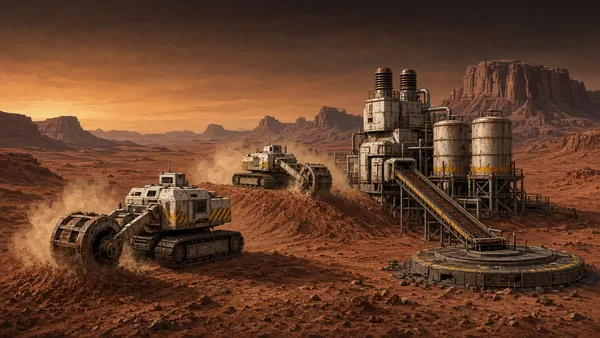
Forget hauling gold back to Earth. Shipping anything home from the Moon or Mars costs too much to pay off for a long time. The first real space mining business is the one NASA files under in-situ resource utilization, or ISRU: making water, oxygen, propellant and building material where you are, so you don’t have to launch them.
It breaks into four steps, and they’re at very different stages.
Find it, dig it, cook it, use it
Prospecting comes first, and it’s harder than it looks. Orbiters flag candidates, such as hydrogen near the lunar poles or buried ice on Mars, and the Planetary Science Institute’s SWIM project has stitched orbital data into maps of where Martian subsurface ice is likely within reach. “Likely” is the important word. Someone still has to drive there and drill.
Excavation sounds like the easy part until you meet regolith. It’s abrasive, it clings to everything, and in low gravity a digger has little weight to push against. That’s why designs lean toward light machines that scoop instead of bulldoze, such as bucket drums and augers.
Processing is where value appears. Heat icy soil and you can capture water, which works as drinking water, as radiation shielding, and, once split into hydrogen and oxygen, as rocket propellant. Mars offers a second option. Its air is mostly carbon dioxide, and NASA’s MOXIE experiment on Perseverance repeatedly made oxygen from it on the surface, the first ISRU demonstration on another planet. Lunar rock holds oxygen too, roughly 40% by mass, but it’s locked in minerals and costs a lot of energy to free.
Local use is the economic point of all this. Fuel made on the Moon or Mars means a lander doesn’t carry fuel for the trip home, and every kilogram not launched from Earth is money saved.
Our view: MOXIE showed the chemistry works. Prospecting is the real bottleneck, because nobody finances a plant to process a deposit they’ve only inferred from orbit.
Who owns any of it
Nobody owns the ground. The 1967 Outer Space Treaty bars countries from claiming sovereignty over the Moon or other bodies. Some national laws, in the US and Luxembourg for example, say companies may own resources they extract. Land is different, so treat any “Mars land deed” as a novelty.
- NASA: Overview of In-Situ Resource Utilization
- Hecht et al., Mars Oxygen ISRU Experiment (MOXIE): Preparing for human Mars exploration, Science Advances (2022)
- NASA Science: Mars 2020 Perseverance science instruments
- Planetary Science Institute: Subsurface Water Ice Mapping (SWIM) project
- UNOOSA: Treaty on Principles Governing the Activities of States in the Exploration and Use of Outer Space (Outer Space Treaty)
Not affiliated with NASA, SpaceX or any agency or company mentioned. Not investment advice. Disclaimer.