

Blue Origin is racing for the first Artemis landing without refueling in orbit. It has to fly again first
NASA will pick its 2028 lander on readiness. Blue Moon's new plan stacks three transfer stages instead of moving propellant, and New Glenn still has to return to flight after May's pad anomaly.
Blue Origin’s launch tower at Cape Canaveral is standing again. CEO Dave Limp said on Oct. 24 that all nine modules of the Vehicle Access Tower at Launch Complex 36A are repaired and back in place, five months after a hot-fire anomaly in May forced major structural repairs, and NASASpaceFlight reports the company is aiming to fly New Glenn again before the end of 2026. Next door, crews poured 4,500 cubic yards of concrete for a second pad, LC-36B, the first of four pours.
That schedule now carries more weight than it did in the spring. NASA’s Oct. 23 lander update confirmed that neither Blue Origin nor SpaceX is assigned to a specific landing anymore. NASA will choose who goes first in 2028 “based on lander readiness,” with a second landing to follow.
So it’s a race, and the two companies are running different routes.
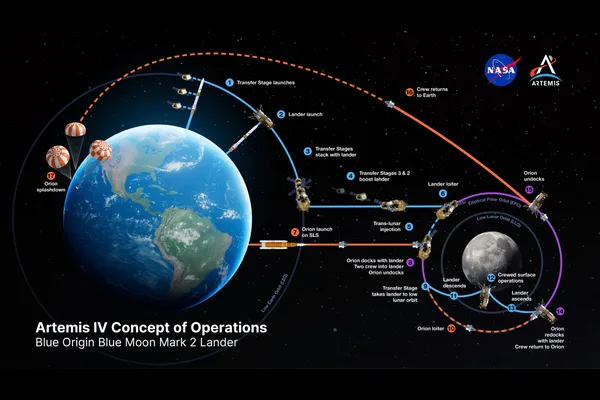
SpaceX is sticking with orbital refueling: tanker Starships top up a depot, which fuels the lander. Blue Origin has dropped propellant transfer for its first crewed attempt. Its plan launches three transfer stages built from Mark 1 and Mark 2 hardware, docks them to the Mark 2 lander in low Earth orbit, and burns them one after another like a multistage rocket to reach an elliptical polar orbit around the Moon. The last stage pushes the lander down to low lunar orbit before descent.
Our read: Blue Origin has traded an unproven technology for a launch-count problem. Every crewed landing needs several New Glenn launches before SLS lifts off, from a company that has to return the rocket to flight first. That’s plainly easier to demonstrate than cryogenic transfer between two ships. It also means the first American landing in more than 50 years might not need a drop of propellant moved in space.
That matters for anyone betting on lunar resources. The case for mining lunar ice rests on future demand for propellant delivered in orbit. If the 2028 landing works without it, refueling slips off NASA’s critical path and onto the list of things that would be nice later. A SpaceX win keeps orbital fuel at the center of the program. A Blue win makes lunar water a longer-dated bet.
The near-term gate is Artemis III. A Mark 2 test article goes up on New Glenn ahead of Orion, the crew docks and spends about two days aboard, and NASA watches both landers perform. Blue Origin expects final hull welding on that test article to finish by January 2027, followed by avionics, flight controls and encapsulation at LC-36A.
For job seekers, the hiring pressure is concentrated in Florida and Huntsville: a lander build on a deadline, a second heavy-lift pad, and a stage-stacking plan that needs rendezvous and propulsion engineers. Our board carries a sample of current Blue Origin openings, and the who hires and where guide covers the Space Coast employers. We covered the docking test itself in our Artemis III piece.
What would change our view: a New Glenn return-to-flight slip into 2027, or a January hull milestone that comes and goes. Either would make the readiness contest a formality.
Mars Mining Co. is an independent news site. It is not affiliated with NASA, JAXA, ESA, SpaceX or any company mentioned. Nothing here is investment advice. Full disclaimer.