

SpaceX caught a Starship coming home from orbit. That's the flight a Moon tanker has to fly
Ship 42 circled Earth 14 times, released 26 Starlink satellites and dropped into the tower's arms. Lunar landings need that trip repeated with propellant aboard, and the transfer itself still hasn't been tried.
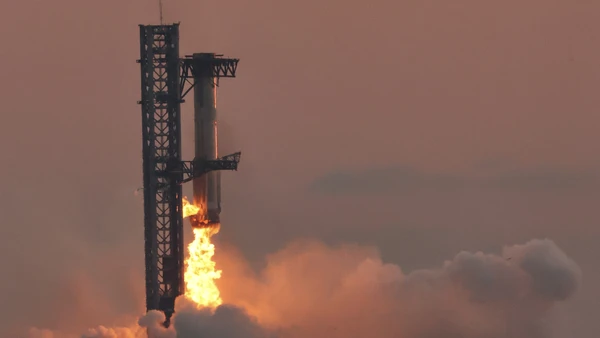
SpaceX caught a Starship upper stage after an orbital flight for the first time on Saturday. Ship 42 lifted off from Pad 2 at Starbase at 5:47 p.m. ET on Nov. 13, deployed 26 Starlink V3 satellites, coasted for more than 20 hours, then relit one Raptor to deorbit. It came back to the same tower about 22.5 hours after it left and was held by the catch arms. SpacePolicyOnline counts 14 orbits.
The booster had a worse day. Booster 22 relit 32 of 33 engines for its boostback, cut the burn short on low fuel mass, aborted on its own and was destroyed offshore after a landing burn over the Gulf. SpaceX is still looking for the root cause. Three boosters have been caught before, so the planned double catch is a miss, though not one that changes the program.
Why a ship catch matters more to the Moon than to Starlink
Look at the shape of this flight. Launch, reach orbit, wait most of a day, come home, get caught. That’s close to what a refueling tanker does, minus the part where it docks and hands over methane and oxygen. Every lunar Starship depends on those tankers. When we covered the Artemis III plan, estimates for the refilling flights behind one landing ran from a NASA safety panel member’s “around 22” down to Elon Musk’s “6 to 8.”
Until Saturday, each of those tankers was a ship you’d throw away. A ship that comes home makes the tanker count less of a manufacturing problem and more of a turnaround problem: how fast can you inspect a returned ship, fix its heat shield and fill it again? Payload reports that Gwynne Shotwell told SpaceX’s third-quarter earnings call the company aims to “refly the second stage by early next year.” Space Scout’s photos show a damaged tile on Ship 42, and the outlet judges this ship unlikely to fly again, which puts heat shield refurbishment at the front of the queue.
For space resources this cuts against the lunar ice business. Our payload math guide argued that propellant shipped from Earth sets the price any lunar water plant has to beat. A reusable tanker pushes that price down. The best case for lunar propellant moves away from low Earth orbit and toward the lunar surface and lunar orbit, where every Earth tonne still has to be hauled the long way.
The job angle is concrete. A reuse program shifts work away from building one-off ships and toward inspection, tile work, ground systems and pads. SpaceX has listings on our board for heat shield technicians, pad electricians and new-grad launch and test engineers, several of them based at Starbase. If you’re coming from aviation maintenance or industrial electrical work, that’s the closest match you’ll find on Starship.
What would change our view: the propellant transfer. SpaceX’s September update targeted a ship-to-ship demo in 2026, and about six weeks of the year are left. If it slips past mid-2027, the catch is mostly a Starlink cost story, and the Moon timeline stays where it was.
- SpaceX: Starship Flight 15 (Nov 13-14, 2026)
- SpacePolicyOnline: SpaceX Catches a Starship (Nov 14, 2026)
- Payload: SpaceX Catches Starship Upper Stage (Nov 14, 2026)
- Space Scout: Starship Returns to its Launch Pad From Orbit (Nov 15, 2026)
- SpaceX: Starship V3 update (Sept 15, 2026)
- Wikimedia Commons: Starship Booster Landing on Mechzilla (Steve Jurvetson, CC BY 2.0)
Mars Mining Co. is an independent news site. It is not affiliated with NASA, JAXA, ESA, SpaceX or any company mentioned. Nothing here is investment advice. Full disclaimer.