

NASA's Mars reactor ship has a design. The hard part is getting rid of the heat
SR-1 Freedom, due to launch in late 2028, will carry three helicopters to Mars to look for buried ice. NASA's latest review fixed the boom and the shielding, but left reactor power, run time and radiator count open. The first big hardware contract went to the radiators.
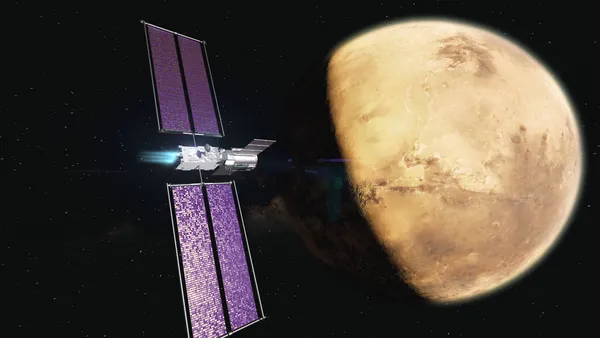
NASA says it has locked in the architecture for Space Reactor-1 Freedom, the fission-powered spacecraft it wants on the late-2028 Mars window. The payload is the part resource people should care about. SR-1 will drop a capsule called SkyFall into Mars orbit, and SkyFall carries three helicopters whose jobs include searching for signs of subsurface ice.
Ice is the first line item in any Mars resource plan. It is water, oxygen and rocket fuel in one deposit, if you can find it shallow enough and power the equipment that digs it out. SR-1 is NASA trying to answer both questions with one launch.
What got decided
The October review at Glenn Research Center made a few calls. The boom holding the reactor away from the spacecraft gets shorter than early drawings showed, to save weight and simplify assembly. Better shielding lets the reactor sit closer to the rest of the vehicle. Bigger X-band dishes go on so the data makes it back from Mars.
What did not get decided is telling. NASA lists the number of radiator panels, the power output of the nuclear module and how long the reactor will run as still under evaluation. Those three numbers are the reactor. The flight plan also has it running for an initial stretch after leaving Earth orbit, shutting down, letting solar arrays carry the cruise, then restarting after SkyFall is delivered. That reads like a demonstration with a careful test card, not a power plant.
The money went to the radiators
The one contract named in the update is $39.3 million to the Johns Hopkins Applied Physics Laboratory for the heat rejection system, with Advanced Cooling Technologies supplying heat pipes and composite radiators. NASA frames it as groundwork for an industrial base for future high-power systems.
Our read: this is the right order. A reactor in space is mostly a radiator problem, because vacuum gives you nowhere to dump waste heat except by glowing it away. Any Mars mine running on fission inherits the same problem at a bigger scale. We covered the Moon version last week, when NASA sized its first lunar reactor at 20 kilowatts.
Where the work is
Thermal is a niche on our board. Today we list 12 openings with thermal in the title. Vast is hiring a Senior Thermal Engineer for lunar work, Relativity Space has a New Grad 2027 Thermal Engineer I role, and Astranis and Muon Space both list thermal internships for 2027. See Vast, Relativity Space and Astranis.
The reactor side hires on the ground first. Kairos Power has 44 openings with us and Oklo has 11, including a Radiation Safety Officer in Idaho Falls. Neither builds spacecraft. Both train people in the shielding, safety analysis and fuel handling that SR-1 depends on, and that experience travels. For the ice side of the story, start with our Mars regolith chemistry guide.
Mars Mining Co. is an independent news site. It is not affiliated with NASA, JAXA, ESA, SpaceX or any company mentioned. Nothing here is investment advice. Full disclaimer.